Introduction
There is a cookie tin on my counter that never stays full for long, and these Classic Butter Shortbread Cookies are the reason. They are the cookies I bake when I want the house to smell like a bakery and the afternoon to slow down — the ones that turn an ordinary cup of tea into a small occasion.
Shortbread asks for almost nothing: good butter, sugar, flour and a pinch of salt. That is exactly why it has survived for generations. There is nowhere for an average ingredient to hide, but there is also nothing to fuss over — no leavening to measure, no frosting to pipe, no mixer gymnastics. Just a soft dough, a rolling pin, and the patience to let the edges turn the palest shade of gold.
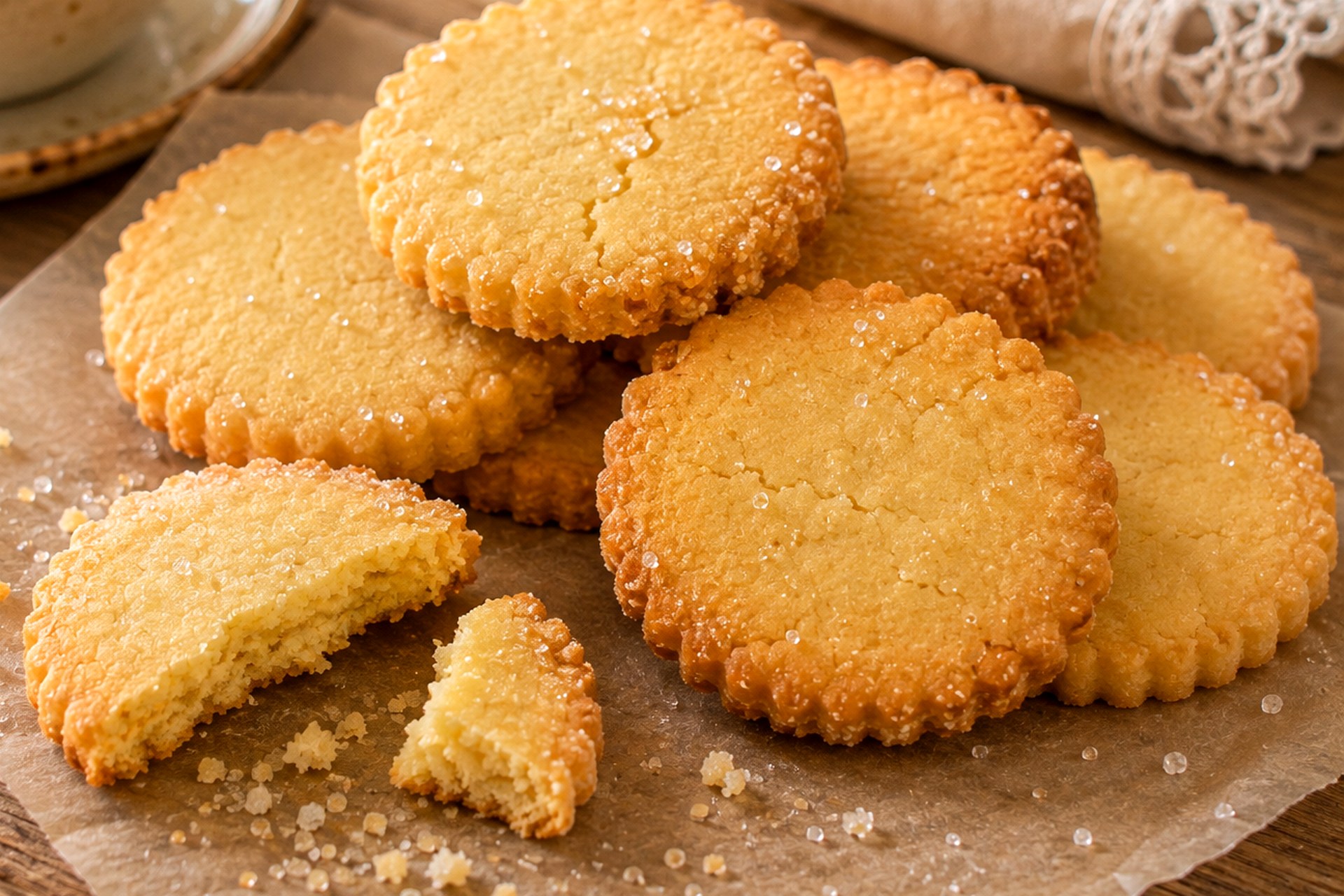
I love them plain, still slightly warm, with their sparkling sugar edges and that crumb that collapses into pure butter the second it hits your tongue. But they are also the most generous cookie I know: dip them in chocolate, tuck them into gift boxes, stack them on a holiday tray. They behave beautifully every single time.

Classic Butter Shortbread Cookies
Ingredients
Equipment
Method
- In a large mixing bowl, cream the softened butter and the 1/2 cup granulated sugar together until light and fluffy, 2 to 3 minutes. Beat in the vanilla if using.
- Add the flour and salt and mix on low speed just until a soft dough forms and no dry flour remains. Stop as soon as it comes together — overmixing makes shortbread tough instead of delicate.
- Gather the dough into a flat disk, wrap it well, and refrigerate for 30 to 60 minutes, until firm but still pliable.
- Preheat the oven to 350°F (175°C). Line a baking sheet with parchment paper.
- On a lightly floured surface, roll the chilled dough to 1/4-inch (6 mm) thickness, turning it as you go so it rolls evenly.
- Cut into round scalloped cookies (about 2½ inches across) and place them on the prepared baking sheet, a little apart. Prick the tops with a fork for the classic shortbread look.
- Roll the edges of each cookie lightly in the coating sugar (or sprinkle coarse sugar over the tops instead, as the original notes suggest).
- Bake for 12 to 15 minutes, until the edges are just turning lightly golden and the centers stay pale. Do not let them brown deeply — pale is what keeps them tender.
- Cool on the baking sheet for 5 minutes, then transfer to a wire rack and cool completely before serving or storing.
Notes
Why You’ll Love This Recipe
- Four everyday ingredients — butter, sugar, flour and salt do all the work; no eggs, no leavening, no surprises.
- That true shortbread crumb — crisp at the edges, tender in the middle, and it genuinely melts in your mouth.
- Beginner-proof — one bowl, one rolling pin, and dough that forgives almost everything except impatience.
- Made for make-ahead — the dough chills for days or freezes for months, and the baked cookies keep for a week.
- A blank canvas — chocolate-dipped, citrus-zested, sandwiched with jam… one dough, a dozen personalities.
- Holiday-tin royalty — sturdy, sliceable, giftable, and still delicious on day five.
Tips from Chef Lea
- Butter is the recipe, so buy like it matters. With only four ingredients, the butter carries the entire flavor. I reach for a good European-style unsalted butter (higher butterfat means a richer, cleaner melt) and I let it soften until it holds a fingerprint but is nowhere near shiny or melted — about 65–68°F if you like numbers. Melted or greasy butter is the number-one cause of shortbread that spreads into puddles and bakes up heavy instead of crumbly.
- Cream for lightness, then stop the mixer. Beat the butter and sugar a full 2 to 3 minutes, until pale and fluffy — that trapped air is part of what keeps these tender instead of dense. But the moment the flour goes in, switch to low and mix only until the last dry streak disappears. Every extra second of mixing develops gluten, and gluten is what turns a delicate shortbread into a tough, bready cookie. I finish the last few folds by hand with a spatula so I can feel when the dough is right.
- Cold dough is how you keep those pretty scalloped edges. Warm shortbread dough relaxes in the oven and the fluted edges blur. Chill the disk 30 to 60 minutes before rolling, and if your kitchen is warm — or you rolled and re-rolled the scraps — slide the cut cookies back into the fridge for 10 minutes on the tray before they bake. Cold dough going into a hot oven is the whole secret to cookies that come out looking exactly like the cutter you used.
- Roll to exactly 1/4 inch (6 mm) — everywhere. Shortbread’s crisp-edge/tender-center magic lives at that thickness. Thinner spots brown and harden while thicker spots stay doughy. I roll between two wooden dowels (or use rolling-pin guide rings) and turn the dough a quarter turn every few passes. Flour the surface lightly — just enough to prevent sticking — because every extra dusting of flour worked into the dough makes the crumb drier.
- Bake them pale, and trust the cooling rack. Pull the tray when the edges show the faintest gold and the centers still look pale and almost soft — around 12 to 15 minutes at 350°F (175°C). They will feel underdone; they are not. Shortbread firms up as it cools, and five minutes on the hot tray finishes the job. If you wait for deep golden color, you have baked the melt right out of them and they will eat hard instead of tender.
- The fork pricks are not decoration — dock like you mean it. Pricking the tops (the classic shortbread docking) lets steam escape so the cookies bake flat and even instead of puffing or blistering in the middle. And roll the raw edges in sugar before baking, not after: the crystals bake into a delicate, sparkling crust that shatters lightly when you bite, which no dusting afterwards can imitate.
Variations
- Chocolate-dipped — Dip half of each cooled cookie in melted dark, milk or white chocolate; set on parchment until firm. A pinch of flaky salt on the chocolate is never wrong.
- Citrus zest — Rub 1 tablespoon of finely grated lemon or orange zest into the sugar before creaming for a bright, sunny crumb.
- Lavender or rosemary — Add 1 teaspoon of finely chopped fresh rosemary or culinary lavender buds for an elegant, tea-party twist.
- Cinnamon sugar edges — Stir 1/2 teaspoon of ground cinnamon into the coating sugar before rolling the edges.
- Almond shortbread — Replace the vanilla with 1/2 teaspoon of almond extract for a subtle marzipan warmth.
- Sandwich cookies — Spread raspberry jam, caramel or chocolate ganache between pairs of cooled cookies.
- Extra-tender version — For an even softer crumb, replace the granulated sugar with 1/2 cup powdered sugar and swap 2 tablespoons of the flour for 2 tablespoons of cornstarch. Expect a finer, more delicate cookie that absolutely dissolves — and handle it gently, it is fragile.
Make Ahead & Storage
- Room temperature — Store completely cooled cookies in an airtight tin or container for up to 1 week, with a sheet of parchment between layers so the sugared edges don’t scuff each other. Shortbread actually improves on day two as the butter flavor settles in.
- Refrigerator — Not required, but an airtight container in the fridge keeps them up to 2 weeks; bring them back to room temperature for 15 minutes before serving so the butter softens and the flavor opens up.
- Freezer (baked) — Freeze baked cookies in a rigid, airtight container (they are too delicate for bags) with parchment between layers, for up to 3 months. Thaw at room temperature for about 30 minutes.
- Make the dough ahead — The wrapped disk keeps in the refrigerator for up to 3 days (let it sit at room temperature 10 to 15 minutes before rolling if it is rock-hard) or in the freezer for up to 3 months; thaw frozen dough overnight in the refrigerator before rolling and baking.
- To refresh — Warm stored cookies in a 300°F (150°C) oven for 3 to 5 minutes to bring back the fresh-baked aroma and delicate crispness. Let them cool a minute before eating — they crisp as they stand.
Frequently Asked Questions
Why is my shortbread dough so crumbly it won’t come together?
Shortbread is a naturally dry, high-butter dough, so a shaggy bowl is normal at first. Keep mixing on low a little longer, or press and knead the dough gently with your hands — the warmth brings the butter around the flour and it will form a smooth disk. If it is still stubbornly dry (usually from a heavy hand with the flour), work in 1 teaspoon of milk at a time. For the next batch, spoon and level the flour instead of scooping, which can pack in up to 25% extra.
Do I really have to chill the dough?
Yes — this is the step that protects both shape and texture. Chilling firms the butter so the cookies hold their scalloped edges instead of spreading, and it lets the flour hydrate, which gives a more even, tender crumb. Thirty minutes is the minimum; an hour is better; overnight is fine too. If you skip it, expect flatter cookies with blurred edges that bake up a little greasy.
Can I use salted butter?
You can, and many home bakers do. Simply omit the 1/4 teaspoon of added salt so the flavor stays balanced — different brands of salted butter vary a lot in saltiness, so taste your dough (yes, really) and adjust. Unsalted butter remains my first choice here because it puts you in control and its flavor is usually cleaner in such a simple recipe.
Why did my cookies spread and lose their shape?
Almost always, the dough went into the oven too warm — either the butter was too soft at mixing, the chill was skipped or too short, or the cut cookies sat in a hot kitchen while the oven preheated. The fix is boring and reliable: cold dough, cold tray, hot oven. Also check your oven temperature with a thermometer; an oven running cool melts the butter before the structure sets.
Can I freeze shortbread dough or baked cookies?
Both freeze beautifully, which is why this is my go-to holiday recipe. The dough disk freezes for up to 3 months (thaw overnight in the fridge, then roll and bake as written). Baked cookies freeze for up to 3 months in a rigid airtight container with parchment between layers, and they thaw at room temperature in about 30 minutes with their texture intact.
Granulated or powdered sugar — which makes the most tender shortbread?
Granulated sugar, used in the card here, gives the classic crumb: delicate, with the faintest pleasant grain and crisp edges. Powdered sugar dissolves completely into the butter, producing a finer, softer, more melt-away cookie — lovely, but more fragile. Neither is wrong; they are two personalities of the same cookie. If you try the powdered version, see the extra-tender variation above.
More Dessert Recipes You’ll Love
- Gooey Biscoff Cookie Butter Cookies
- Fudgy Brownie Cookies with Crackly Tops and Gooey Chocolate Centers
- Chewy Spiced Cookie Butter Bars with Dark Chocolate
Conclusion
Some recipes impress with a long ingredient list, and some impress by asking for almost nothing and delivering everything. These Classic Butter Shortbread Cookies are firmly the second kind. Four humble ingredients, one bowl, and a little patience at the oven door — that is all that stands between you and a tin of golden, sugar-edged cookies that melt the second they meet your tongue. Bake a batch for the tea tray, another for the gift boxes, and keep the dough disk in the freezer for the days when only warm shortbread will do. Simple has never tasted this good.
Follow along for a new recipe every day: Facebook — Lea Recipes Kitchen · Pinterest — @learecipes · Instagram — @lea_recipes1. Made these cookies? Leave a comment and a star rating below — it helps other bakers find the recipe!

Leave a Reply