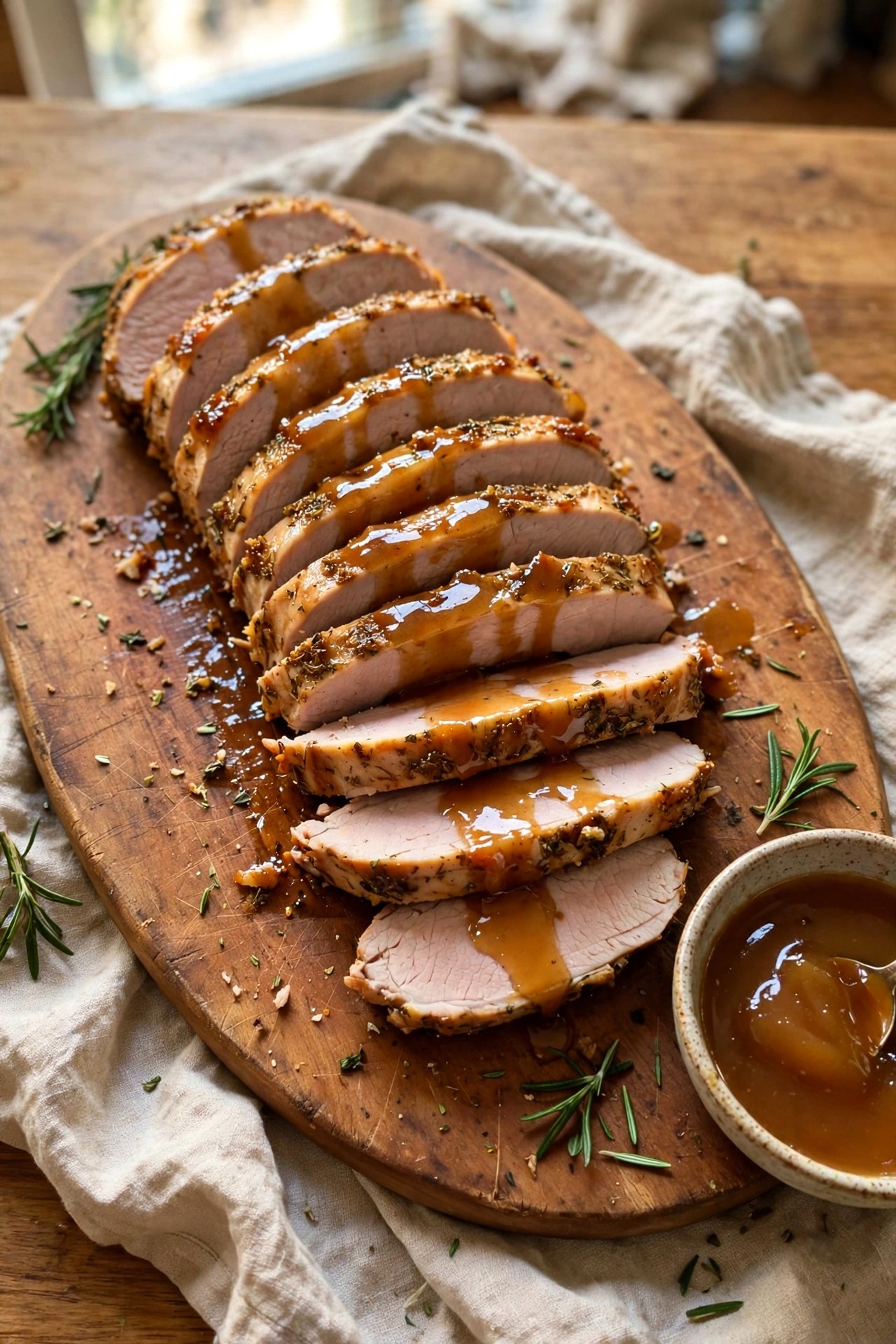
Herb-Crusted Pork Tenderloin with Apple Cider Glaze
Prep Time: 20 minutes | Cook Time: 25 minutes | Total Time: 55 minutes (including 10 minutes resting) | Servings: 6
When I want a Christmas main that looks like I worked on it all afternoon but absolutely did not, this is the one I reach for. A pork tenderloin gets a thick, fragrant crust of fresh rosemary, thyme, garlic and a little Dijon to help it stick, roasts until it is golden and juicy, and gets finished with a glossy apple cider glaze that reduces down into something halfway between a sauce and a shine. It slices like a dream, it tastes like the holidays, and it is on the table in under an hour.
It is the savory half of today’s holiday pair — for dessert I am serving my Eggnog Cheesecake Bars, and the warm spices in the bars pick up the apple and herbs in the glaze beautifully. If you are building a bigger Christmas menu around it, it sits right at home next to the Christmas Ham with Brown Sugar Glaze from Day 1 of this series — two centerpieces, two completely different moods, and nobody at the table feels short-changed.
Ingredients
- For the herb crust:
- 2 tablespoons fresh rosemary leaves, finely chopped
- 1 tablespoon fresh thyme leaves
- 4 garlic cloves, minced
- 1 teaspoon lemon zest
- 1 teaspoon kosher salt
- 1/2 teaspoon black pepper
- 1/4 teaspoon ground cinnamon
- 2 tablespoons olive oil
- 1 tablespoon Dijon mustard
- For the pork:
- 2 pork tenderloins (about 1 1/4 pounds each, 2 1/2 pounds total), silver skin removed
- 1 tablespoon olive oil, for searing
- For the apple cider glaze:
- 1 1/2 cups apple cider (not apple juice)
- 2 tablespoons honey
- 1 tablespoon apple cider vinegar
- 1 tablespoon unsalted butter
- 1 pinch of salt
Instructions
- Heat the oven to 425°F (220°C). Take the tenderloins out of the fridge 20 minutes before cooking so they roast evenly, and pat them completely dry with paper towels — a dry surface is what lets the crust stick and brown.
- Make the herb crust: stir the rosemary, thyme, garlic, lemon zest, salt, pepper, cinnamon, 2 tablespoons olive oil and the Dijon together into a thick, fragrant paste. Rub it over every side of both tenderloins, pressing it on with your hands so it adheres in an even layer.
- Sear for color and flavor: heat the remaining 1 tablespoon of olive oil in a large oven-safe skillet over medium-high heat until it shimmers. Lay the tenderloins in and sear for 2 minutes per side, 8 minutes in total, until the crust is deep golden in spots. Do not skip this — the sear is where the crust gets its flavor.
- Transfer the skillet to the oven and roast at 425°F (220°C) for 15 to 18 minutes, until an instant-read thermometer pushed into the thickest part reads 145°F (63°C). Tenderloins are lean and cook fast; start checking at 15 minutes, because 5 extra minutes is the difference between juicy and dry.
- Move the pork to a cutting board, tent it loosely with foil, and rest it for 10 minutes. The temperature will hold and the juices will settle back into the meat — slicing early sends all of that juice onto the board instead.
- While the pork rests, make the glaze in the same skillet: pour in the apple cider, honey and apple cider vinegar, scraping up all the browned bits from the bottom. Simmer over medium heat for 6 to 8 minutes, until it has reduced by about half and coats the back of a spoon in a glossy layer. Take it off the heat and whisk in the butter and the pinch of salt until it shines.
- Slice the tenderloins into 1/2-inch medallions — you should see a blush of pale pink in the centers, which is exactly right at 145°F (63°C). Fan the slices out on a warm platter, spoon the warm glaze generously over the top, and serve the rest of the glaze at the table.
Why You’ll Love This Recipe
- A centerpiece in 55 minutes: all the ceremony of a holiday roast, none of the all-day roasting — most of the time is hands-off.
- Juicy, never dry: a fast sear, a hot oven and a proper rest, judged by thermometer instead of guesswork.
- That glaze: real apple cider reduced to a glossy, sweet-tart shine that tastes like Christmas in a spoonful.
- Two tenderloins, one pan: enough for six at dinner, with slices left over for the best sandwiches of December.
Tips from Lea Bennett
- Remove the silver skin, every time: that thin, silvery strip down one side of the tenderloin does not soften as it cooks — it tightens and makes the meat curl and chew tough. Slide a thin knife under one end, angle the blade up, and pull it away in one or two strips before the crust goes on.
- Dry meat, stuck crust: if the tenderloins go into the paste wet, the crust slides right off in the pan. Pat them dry, rub the paste on firmly, and let them sit for 10 minutes before searing — that short wait works like glue.
- Trust the thermometer, not the clock: tenderloins vary in thickness by brand, and at 425°F (220°C) the window between perfect and dry is only a few minutes. Pull at 145°F (63°C) in the thickest part — the slices will be juicy with a pale-pink blush, which is exactly how pork tenderloin should be served.
- Reduce the glaze until it coats a spoon: if it runs off the spoon like water, keep simmering — another 2 minutes makes the difference between a puddle and a glaze. It should leave a clear line when you drag a finger across the back of the spoon, and it thickens a touch more as it cools.
- Slice against the grain, on a slight angle: tenderloin grain runs lengthwise, so crosswise slices are the tender ones. Angling the knife just a little gives you wider, prettier medallions that fan out beautifully under the glaze.
Variations
- Maple-herb version: swap the honey in the glaze for maple syrup and drop the cinnamon — deeper, woodsier, very New England.
- Mustard-forward: double the Dijon in the crust and whisk 1 extra teaspoon into the finished glaze for a sharper, more grown-up edge.
- Slow-roasted version: skip the sear, roast at 375°F (190°C) for 25 to 30 minutes to the same 145°F (63°C), and brown the top under the broiler for 2 minutes at the end if you miss the crust.
- One tenderloin: halve the crust and glaze and roast a single tenderloin for 4 servings — same temperatures, start checking at 12 minutes.
Make Ahead & Storage
Make ahead: The herb paste can be mixed and rubbed onto the pork up to 24 hours ahead — wrap it well and refrigerate; that overnight rest honestly makes the crust more flavorful. The glaze can be made 2 days ahead and refrigerated; rewarm it gently and whisk in a splash of cider if it has thickened too much.
Fridge: Leftover slices keep in an airtight container, with any extra glaze spooned over them, for up to 3 days. The glaze on top is not just for looks — it keeps the lean meat from drying out.
Reheating: Warm slices gently in a covered skillet over low heat with a spoonful of glaze or cider, just until heated through, about 4 minutes. A hot oven or a long microwave blast will dry tenderloin out — low and covered is the whole secret. Cold slices are also fantastic in sandwiches with a smear of Dijon.
Freezer: Freeze the cooked, unsliced tenderloin, well wrapped, for up to 2 months. Thaw overnight in the fridge, slice, and rewarm as above with fresh glaze for the best texture.
FAQ
Is a blush of pink in the center safe?
Yes — pork cooked to 145°F (63°C) with a 10-minute rest is the current recommended standard, and at that temperature the center is often faintly pink. That blush means juicy, properly cooked pork, not raw pork. Judge by the thermometer reading, not by color alone.
Can I use apple juice instead of apple cider?
You can, but the glaze will be sweeter and flatter. If juice is what you have, increase the apple cider vinegar to 2 tablespoons and reduce the honey to 1 tablespoon to bring back the sweet-tart balance that makes the glaze work.
What if I do not have an oven-safe skillet?
Sear in any skillet, then move the tenderloins to a parchment-lined rimmed baking sheet for the oven. Make the glaze in the searing skillet as written — all the browned flavor is in there — and add 1 tablespoon of water when you scrape it up if the bits look dry.
What sides go with this for Christmas dinner?
Anything that loves a sweet-tart glaze: mashed or roasted potatoes, green beans, a simple stuffing, or roasted carrots. The version I make most often is my honey caramelized carrots with whipped feta — their honeyed edges mirror the cider glaze, and the salty feta keeps every bite balanced. The glaze pooling on the plate is wonderful dragged through mashed potatoes — plan for it.
Can I make this with a pork loin instead?
A loin is a different, thicker cut and needs longer: roast a 3-pound loin at 375°F (190°C) for 45 to 55 minutes to the same 145°F (63°C), resting 15 minutes. The crust and glaze quantities work as written; double the glaze if you like plenty for the table.
More Dinner Recipes You’ll Love
- Eggnog Cheesecake Bars
- Christmas Ham with Brown Sugar Glaze
- Slow Cooker Party Meatballs
- Best Thanksgiving Recipes
Conclusion
Golden herb crust, juicy slices, and that glossy apple cider glaze catching the light — this tenderloin is my favorite kind of holiday cooking: impressive on the platter, easy in the kitchen. Make it the center of your Christmas table this year, and watch it disappear. Merry Christmas from my kitchen to yours! 🎄
Follow along for a new recipe every day: find me on Facebook at Lea Recipes Kitchen, on Pinterest at @learecipes, and on Instagram @lea_recipes1. If you make this tenderloin, I’d love it if you’d leave the recipe a star rating and a comment — it truly helps other home cooks find it. Thank you! 🎄

Herb-Crusted Pork Tenderloin with Apple Cider Glaze
Ingredients
Equipment
Method
- Heat the oven to 425°F (220°C). Take the tenderloins out of the fridge 20 minutes before cooking so they roast evenly, and pat them completely dry with paper towels — a dry surface is what lets the crust stick and brown.
- Make the herb crust: stir the rosemary, thyme, garlic, lemon zest, salt, pepper, cinnamon, 2 tablespoons olive oil and the Dijon together into a thick, fragrant paste. Rub it over every side of both tenderloins, pressing it on with your hands so it adheres in an even layer.
- Sear for color and flavor: heat the remaining 1 tablespoon of olive oil in a large oven-safe skillet over medium-high heat until it shimmers. Lay the tenderloins in and sear for 2 minutes per side, 8 minutes in total, until the crust is deep golden in spots. Do not skip this — the sear is where the crust gets its flavor.
- Transfer the skillet to the oven and roast at 425°F (220°C) for 15 to 18 minutes, until an instant-read thermometer pushed into the thickest part reads 145°F (63°C). Tenderloins are lean and cook fast; start checking at 15 minutes, because 5 extra minutes is the difference between juicy and dry.
- Move the pork to a cutting board, tent it loosely with foil, and rest it for 10 minutes. The temperature will hold and the juices will settle back into the meat — slicing early sends all of that juice onto the board instead.
- While the pork rests, make the glaze in the same skillet: pour in the apple cider, honey and apple cider vinegar, scraping up all the browned bits from the bottom. Simmer over medium heat for 6 to 8 minutes, until it has reduced by about half and coats the back of a spoon in a glossy layer. Take it off the heat and whisk in the butter and the pinch of salt until it shines.
- Slice the tenderloins into 1/2-inch medallions — you should see a blush of pale pink in the centers, which is exactly right at 145°F (63°C). Fan the slices out on a warm platter, spoon the warm glaze generously over the top, and serve the rest of the glaze at the table.

Leave a Reply