Best Baked Mac and Cheese
Prep Time: 20 minutes | Cook Time: 40 minutes | Total Time: 65 minutes (includes 5 minutes resting) | Servings: 10 servings as a side (6 as a main)
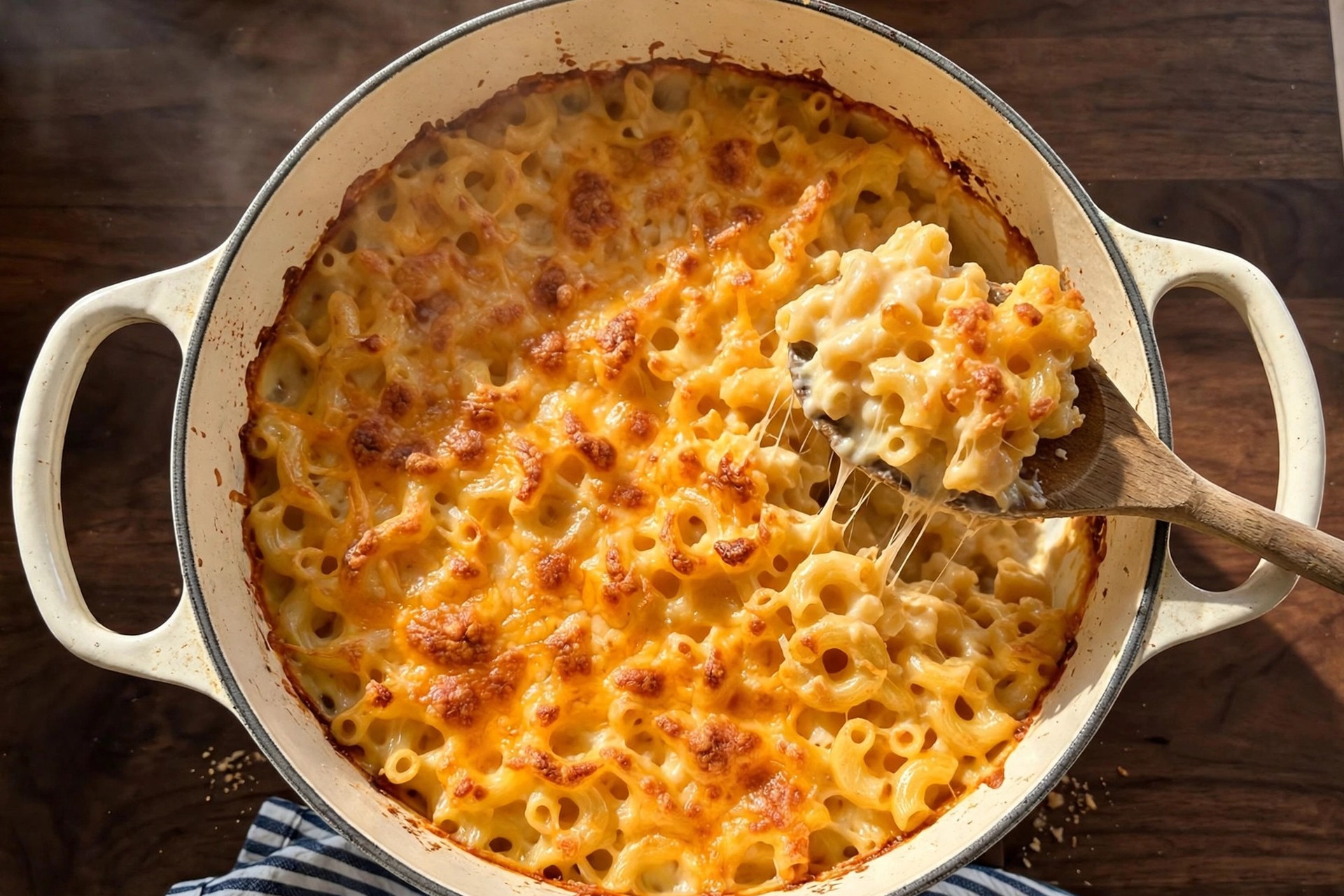
There is a reason baked mac and cheese keeps showing up at the top of America’s most-wanted side dish lists — and why, once the dish hits the table, it is always the first one scraped clean. This is my best version: elbow macaroni folded into a smooth, deeply cheesy béchamel made with sharp cheddar for bold flavor and Gruyère for that nutty, stretchy melt, all baked in a 9×13-inch dish at 350°F (175°C) under a golden, crunchy panko crust. The inside stays creamy and saucy, the top turns crisp and golden, and every spoonful pulls those long, satisfying cheese strands.
On a Thanksgiving table it earns its oven space next to the classics I already lean on every year — my Classic Sage Stuffing and my Classic Sweet Potato Casserole with Pecan Crumble from earlier in this series, one savory and herb-filled, one sweet and crunchy, with this creamy mac and cheese right in the middle bringing everyone back for seconds. It follows yesterday’s soup in this series, my Thai Coconut Chicken Soup (Tom Kha Gai), and the contrast could not be happier: bright and fragrant one day, rich and golden the next. The whole secret here is in three small habits — grate the cheese yourself, cook the pasta just shy of done, and take the sauce off the heat before the cheese goes in. Do those three things and the sauce stays silky, never grainy, every single time.

Best Baked Mac and Cheese
Ingredients
Method
- Prep and heat the oven (20 minutes): position a rack in the center of the oven and heat the oven to 350°F (175°C). Butter a 9×13-inch baking dish with the 1 teaspoon of unsalted butter, or coat it with cooking spray. Shred all the cheese by hand while it is still cold from the fridge — the 12 ounces of sharp cheddar (about 3 cups) and the 8 ounces of Gruyère (about 2 cups) — and toss them together in one large bowl, then set aside 1 cup of the cheddar from that total for the top of the dish. Measure the flour, milk, cream and seasonings, and stir the topping together in a small bowl: the 1 1/2 cups of panko, the 2 tablespoons of melted butter, the 1 ounce of finely grated Parmesan (about 1/4 cup) and the 1/2 teaspoon of smoked paprika for the topping, mixed until the crumbs look like damp sand. Bring a large pot of water to a boil for the pasta. This 20 minutes of prep is what makes the sauce calm to cook — cheese sauce does not wait well, so everything needs to be ready before the butter melts.
- Cook the pasta (7 minutes): add the 1 tablespoon of kosher salt and the 1 pound of elbow macaroni to the boiling water, stir well so nothing sticks, and cook for 7 minutes, until the pasta is just shy of al dente — tender at the edges but still firm with a definite bite in the center. The elbows will finish cooking in the oven, and pasta cooked all the way on the stove turns soft and swollen after baking. Drain the pasta well, return it to the warm empty pot off the heat, and set it aside — do not rinse it, because the light starch on its surface helps the sauce cling.
- Make the cheese sauce (8 minutes): in a large, heavy pot or Dutch oven, melt the 6 tablespoons of unsalted butter over medium heat. Whisk in the 1/2 cup of flour and cook, whisking constantly, for 2 minutes, until the roux is smooth, bubbling and pale golden — this cooks out the raw flour taste without browning it. Slowly pour in the 4 cups of whole milk a little at a time, whisking hard after each addition so no lumps form, then whisk in the 1 cup of heavy cream. Cook for 4 minutes, whisking often and then constantly as it thickens, until the béchamel comes to a gentle simmer and coats the back of a spoon thickly. Whisk in the 1 teaspoon of dry mustard powder, the 1/2 teaspoon of garlic powder, the 1/2 teaspoon of smoked paprika for the sauce, the 1 teaspoon of fine sea salt, the 1/2 teaspoon of black pepper and the 1/8 teaspoon of cayenne pepper. Then take the pot completely off the heat and wait for 1 minute before adding the cheese, and use the final 1 minute of those 8 minutes to stir in the mixed cheeses in 3 handfuls, keeping the reserved 1 cup of cheddar aside, and stir gently after each handful until it melts completely before adding the next. Off the heat, the cheese melts smooth and glossy; in a boiling sauce, it can turn grainy and oily.
- Combine and fill the dish: pour the warm, drained pasta into the cheese sauce and fold gently until every elbow is coated and the pot looks generously saucy — it should look a little looser than you expect, because the pasta keeps absorbing sauce in the oven. Scrape everything into the prepared 9×13-inch dish and spread it into an even layer. Scatter the reserved 1 cup of shredded cheddar evenly over the top, then sprinkle the buttered panko topping over the whole surface, edge to edge, so every serving gets some crunch.
- Bake (25 minutes): bake, uncovered, at 350°F (175°C) for 25 minutes, until the sauce is bubbling up around the edges, the cheese on top has melted, and the panko crust is deep golden brown. If the top is browning much faster than the center is bubbling, lay a sheet of foil loosely over the dish for the remaining minutes — but in a 9×13-inch dish at 350°F (175°C), 25 minutes is normally exactly right for a crisp top and a creamy, scoopable center.
- Rest and serve (5 minutes): remove the dish from the oven and let the mac and cheese rest, uncovered, for 5 minutes before serving. This short rest is part of the recipe, not an afterthought: the sauce thickens from runny to creamy and coats the pasta instead of pooling in the dish, and the servings hold together on the spoon. Serve warm, straight from the dish, spooning down through the golden crust so each of the 10 side servings (or 6 main servings) gets both crunch and cream.
Notes
Ingredients
- For the pasta and dish:
- 1 pound (16 ounces) elbow macaroni
- 1 tablespoon kosher salt, for the pasta water
- 1 teaspoon unsalted butter, for the 9×13-inch dish — or cooking spray
- For the cheese sauce:
- 6 tablespoons unsalted butter
- 1/2 cup all-purpose flour
- 4 cups whole milk, warmed or at room temperature
- 1 cup heavy cream
- 1 teaspoon dry mustard powder
- 1/2 teaspoon garlic powder
- 1/2 teaspoon smoked paprika
- 1 teaspoon fine sea salt
- 1/2 teaspoon freshly ground black pepper
- 1/8 teaspoon cayenne pepper
- 12 ounces sharp cheddar cheese, freshly shredded (about 3 cups, lightly packed), divided
- 8 ounces Gruyère cheese, freshly shredded (about 2 cups, lightly packed)
- For the breadcrumb topping:
- 1 1/2 cups panko breadcrumbs
- 2 tablespoons unsalted butter, melted
- 1 ounce Parmesan cheese, finely grated (about 1/4 cup)
- 1/2 teaspoon smoked paprika
Instructions
- Prep and heat the oven (20 minutes): position a rack in the center of the oven and heat the oven to 350°F (175°C). Butter a 9×13-inch baking dish with the 1 teaspoon of unsalted butter, or coat it with cooking spray. Shred all the cheese by hand while it is still cold from the fridge — the 12 ounces of sharp cheddar (about 3 cups) and the 8 ounces of Gruyère (about 2 cups) — and toss them together in one large bowl, then set aside 1 cup of the cheddar from that total for the top of the dish. Measure the flour, milk, cream and seasonings, and stir the topping together in a small bowl: the 1 1/2 cups of panko, the 2 tablespoons of melted butter, the 1 ounce of finely grated Parmesan (about 1/4 cup) and the 1/2 teaspoon of smoked paprika for the topping, mixed until the crumbs look like damp sand. Bring a large pot of water to a boil for the pasta. This 20 minutes of prep is what makes the sauce calm to cook — cheese sauce does not wait well, so everything needs to be ready before the butter melts.
- Cook the pasta (7 minutes): add the 1 tablespoon of kosher salt and the 1 pound of elbow macaroni to the boiling water, stir well so nothing sticks, and cook for 7 minutes, until the pasta is just shy of al dente — tender at the edges but still firm with a definite bite in the center. The elbows will finish cooking in the oven, and pasta cooked all the way on the stove turns soft and swollen after baking. Drain the pasta well, return it to the warm empty pot off the heat, and set it aside — do not rinse it, because the light starch on its surface helps the sauce cling.
- Make the cheese sauce (8 minutes): in a large, heavy pot or Dutch oven, melt the 6 tablespoons of unsalted butter over medium heat. Whisk in the 1/2 cup of flour and cook, whisking constantly, for 2 minutes, until the roux is smooth, bubbling and pale golden — this cooks out the raw flour taste without browning it. Slowly pour in the 4 cups of whole milk a little at a time, whisking hard after each addition so no lumps form, then whisk in the 1 cup of heavy cream. Cook for 4 minutes, whisking often and then constantly as it thickens, until the béchamel comes to a gentle simmer and coats the back of a spoon thickly. Whisk in the 1 teaspoon of dry mustard powder, the 1/2 teaspoon of garlic powder, the 1/2 teaspoon of smoked paprika for the sauce, the 1 teaspoon of fine sea salt, the 1/2 teaspoon of black pepper and the 1/8 teaspoon of cayenne pepper. Then take the pot completely off the heat and wait for 1 minute before adding the cheese, and use the final 1 minute of those 8 minutes to stir in the mixed cheeses in 3 handfuls, keeping the reserved 1 cup of cheddar aside, and stir gently after each handful until it melts completely before adding the next. Off the heat, the cheese melts smooth and glossy; in a boiling sauce, it can turn grainy and oily.
- Combine and fill the dish: pour the warm, drained pasta into the cheese sauce and fold gently until every elbow is coated and the pot looks generously saucy — it should look a little looser than you expect, because the pasta keeps absorbing sauce in the oven. Scrape everything into the prepared 9×13-inch dish and spread it into an even layer. Scatter the reserved 1 cup of shredded cheddar evenly over the top, then sprinkle the buttered panko topping over the whole surface, edge to edge, so every serving gets some crunch.
- Bake (25 minutes): bake, uncovered, at 350°F (175°C) for 25 minutes, until the sauce is bubbling up around the edges, the cheese on top has melted, and the panko crust is deep golden brown. If the top is browning much faster than the center is bubbling, lay a sheet of foil loosely over the dish for the remaining minutes — but in a 9×13-inch dish at 350°F (175°C), 25 minutes is normally exactly right for a crisp top and a creamy, scoopable center.
- Rest and serve (5 minutes): remove the dish from the oven and let the mac and cheese rest, uncovered, for 5 minutes before serving. This short rest is part of the recipe, not an afterthought: the sauce thickens from runny to creamy and coats the pasta instead of pooling in the dish, and the servings hold together on the spoon. Serve warm, straight from the dish, spooning down through the golden crust so each of the 10 side servings (or 6 main servings) gets both crunch and cream.
Why You’ll Love This Recipe
- Creamy inside, crisp on top: a smooth cheddar and Gruyère béchamel that stays saucy after baking, under a golden panko crust in every bite — the two textures that make baked mac and cheese unforgettable.
- Two cheeses, real depth: 12 ounces of sharp cheddar (about 3 cups) bring the bold, familiar flavor, and 8 ounces of Gruyère (about 2 cups) add a nutty richness and a beautiful, stretchy melt.
- Built for the holiday table: one 9×13-inch dish makes 10 side servings, it sits happily beside turkey, stuffing and sweet potatoes, and the make-ahead plan below keeps Thanksgiving Day calm.
- Silky sauce, by method: warm milk whisked in gradually, cheese melted off the heat, and pasta cooked just shy of al dente — three habits that prevent every common mac and cheese problem before it starts.
Tips from Lea Bennett
- Grate the cheese yourself, always: this is the single biggest upgrade I know for this dish. Pre-shredded cheese is coated with anti-caking powders that keep it from melting smoothly, and that coating is a leading cause of a sauce that looks gritty instead of glossy. Buy the 12 ounces of sharp cheddar and the 8 ounces of Gruyère in blocks, shred them on the large holes of a box grater while they are cold, and let the shreds sit out while you prep so they are not fridge-cold when they hit the sauce — cold shreds melt more evenly than a cold clump, and far better than bagged shreds ever will.
- Take the sauce off the heat before the cheese goes in: cheese and boiling liquid do not get along. If the béchamel is bubbling hard when the cheddar and Gruyère go in, the proteins tighten, the fat separates, and the sauce turns grainy and oily in seconds — with no real way back. Off the heat for a full minute, then the cheese in 3 handfuls, stirring until each one melts before the next: that is the whole technique, and it works every time.
- Cook the pasta shy of al dente — 7 minutes, no more: the elbows bake for another 25 minutes at 350°F (175°C) surrounded by sauce, and they absorb liquid the whole time. Pasta that tastes perfectly done on the stove will be soft and swollen by the time the dish rests. At 7 minutes the center should still have a firm bite when you test an elbow — that firmness is your insurance, and the finished dish will be tender, never mushy, with each elbow still holding its shape in the sauce.
- Warm milk makes a smoother sauce: cold milk poured into a hot roux shocks the mixture and invites lumps. I warm the 4 cups of whole milk gently, or at least let them stand at room temperature while I prep, then add the milk a little at a time at the start, whisking hard after each pour until it is fully absorbed before adding more. Once about half the milk is in smoothly, the rest can go in a steady stream, followed by the 1 cup of heavy cream — a lump-free béchamel is mostly patience in the first minute.
- Make the sauce looser than you think: when the pasta first folds in, the dish should look almost too saucy, with the sauce pooling slightly when you tilt the pot. That extra sauce is not a mistake — the pasta drinks it up during the 25 minutes of baking and the 5 minutes of resting. A sauce that looks perfect in the pot comes out of the oven dry. If yours ever looks tight before baking, splash in a little extra warm milk, a spoonful at a time, until it flows again.
- Season the sauce, not just the cheese: cheddar and Gruyère bring salt and flavor, but on their own the finished dish can still taste flat in the middle. The 1 teaspoon of dry mustard powder does not make this taste like mustard — it sharpens the cheese flavor, the way it does in a good cheese sauce — and the 1/2 teaspoon of garlic powder, 1/2 teaspoon of smoked paprika, 1/8 teaspoon of cayenne and the measured salts give the béchamel a backbone. Taste the sauce before the pasta goes in: it should taste boldly seasoned, because the pasta will dilute it.
- Rest the dish for the full 5 minutes: straight from the oven, the sauce is loose and the servings slide. After 5 minutes of resting, the same sauce turns creamy and clinging, the crust stays crisp, and you can spoon out clean, generous servings that hold together on the plate. I set the dish on a trivet, not a cold counter, and I do not cover it — a lid would steam that golden panko crust soft again.
- Use the right dish, in the right size: this recipe is built for a 9×13-inch dish, and the size matters. In a smaller, deeper dish the center stays pale and soupy while the top over-browns; in a larger, shallower one the sauce reduces too far and the pasta dries out. A 9×13-inch dish gives you the correct depth for a creamy center, bubbling edges and a crust that covers every serving.
Variations
- Three-cheese mac and cheese: keep the 12 ounces of sharp cheddar (about 3 cups) and the 8 ounces of Gruyère (about 2 cups), and swap the Parmesan in the topping for the same 1 ounce (about 1/4 cup) finely grated on top of the panko instead of mixed in — or stir 4 ounces of shredded Monterey Jack into the sauce in place of 4 ounces of the Gruyère for an extra-mild, extra-stretchy melt. Bake at 350°F (175°C) for the same 25 minutes.
- Smoky bacon mac and cheese: cook 6 slices of bacon until crisp, crumble them, and fold half into the pasta when you combine it with the sauce and scatter the rest over the panko topping. The smoked paprika already in the sauce echoes the bacon beautifully. Nothing else changes — same dish, same 350°F (175°C), same 25 minutes of baking.
- Buffalo chicken mac and cheese (a main dish): fold 2 cups of shredded cooked chicken and 1/4 cup of Buffalo-style hot sauce into the pasta and sauce before it goes into the dish, and serve it as a main — this version makes 6 generous main servings. Keep the cayenne out if your hot sauce is fiery, and bake at 350°F (175°C) for the same 25 minutes.
- Broccoli cheddar mac and cheese: stir 2 cups of small broccoli florets into the pasta pot for the last 2 minutes of its 7 minutes of cooking, then drain everything together. The florets finish in the oven, stay bright, and make the dish feel a little more like a complete plate — a version my table asks for well beyond Thanksgiving.
Make Ahead & Storage
Make ahead for Thanksgiving: this is the part that makes this recipe a holiday keeper. You have two good options. Option 1 — assemble ahead: make the dish completely — pasta, sauce, cheddar layer and panko topping — up to 1 day ahead, cover the 9×13-inch dish tightly and refrigerate it. On the day, let it stand at room temperature while the oven heats to 350°F (175°C), then bake it covered with foil for the first part of baking so the center warms through, removing the foil for the last part so the crust crisps; a cold dish needs extra time in the oven beyond the 25 minutes of the freshly made version, so judge it by the same signs — sauce bubbling at the edges and a deep golden top — rather than by the clock alone. Option 2 — components ahead: shred the cheeses and stir the panko topping up to 2 days ahead and refrigerate each in its own covered container, then make the pasta and sauce fresh on the day. The sauce itself is best made fresh — a reheated cheese sauce is the one most likely to turn grainy — so I assemble ahead rather than sauce ahead whenever I can.
Fridge: Cool leftovers until no longer steaming, cover the dish or transfer the mac and cheese to an airtight container, and refrigerate for up to 4 days. The pasta keeps absorbing sauce as it sits, so leftovers will always be firmer than the fresh dish — that is normal, and the reheating splash of milk below is the fix.
Reheating: For a portion, add a splash of milk — about 1 tablespoon per cup of mac and cheese — stir it in, and warm it gently in the microwave or in a small pan over low heat, stirring often, until steaming hot and creamy again. For a larger amount, put it in an oven-safe dish, stir in the milk, cover with foil, and reheat at 350°F (175°C) until hot and bubbling at the edges. Avoid reheating uncovered at a high heat: the top dries, the cheese separates, and the sauce you worked to keep silky turns oily.
Freezer: Baked mac and cheese freezes for up to 2 months, with one honest caveat — the sauce is never quite as silky after freezing, because the cheese sauce can separate slightly as it thaws. For the best result, freeze it after baking and cooling, wrapped tightly in the dish or in portions. Thaw overnight in the fridge, stir in a splash of milk, and reheat covered at 350°F (175°C) until hot throughout. If you know a dish is destined for the freezer, underbake it very slightly so the pasta stays firm after its second round in the oven.
FAQ
Why did my mac and cheese sauce turn grainy?
Almost always, the cheese met liquid that was too hot, or the cheese was pre-shredded. A béchamel at a hard boil makes cheese proteins tighten and fat separate, which reads as grainy and oily, and the anti-caking coating on bagged shreds melts into grit instead of silk. The fixes are all in the method here: shred the 12 ounces of cheddar and the 8 ounces of Gruyère yourself, take the sauce off the heat for a full minute, and add the cheese in 3 handfuls, letting each melt before the next.
Can I make baked mac and cheese ahead for Thanksgiving?
Yes — it is one of the best Thanksgiving sides to assemble ahead. Assemble the whole 9×13-inch dish up to 1 day ahead, cover and refrigerate it, and bake it on the day at 350°F (175°C), starting covered with foil and finishing uncovered so the panko turns golden and crisp; a refrigerated dish needs extra time beyond the 25 minutes of the fresh version, so bake it until the sauce bubbles at the edges. Shredding the cheeses and mixing the topping up to 2 days ahead also works beautifully. What I do not recommend is making the cheese sauce alone days ahead — reheated cheese sauce is the version most likely to split.
What are the best cheeses for baked mac and cheese?
You want one bold cheese and one great melter. Here that is 12 ounces of sharp cheddar (about 3 cups) for unmistakable cheddar flavor and 8 ounces of Gruyère (about 2 cups) for nutty depth and a smooth, stretchy melt, with 1 ounce of Parmesan (about 1/4 cup) adding a salty edge to the crust. Avoid very mild cheeses on their own — the dish tastes washed out — and avoid extra-sharp aged blocks as the only cheese, because older cheeses melt less smoothly; sharp cheddar balanced by Gruyère is the pairing that gives you both flavor and silk.
Why cook the pasta for only 7 minutes?
Because it cooks twice. The elbows boil for 7 minutes — just shy of al dente, still firm in the center — and then they bake for 25 minutes at 350°F (175°C) surrounded by hot sauce, absorbing liquid and finishing as they go. Pasta boiled until fully tender on the stove comes out of the oven soft and bloated, and it drinks up so much sauce that the dish turns dry. That firm center at the draining stage is what gives you distinct, tender elbows in a creamy sauce at the table.
Can I serve this as a main dish instead of a side?
Absolutely — that is how it is eaten in my house outside the holidays. As a side, the 9×13-inch dish makes 10 servings; as a main, plan on 6 generous servings, with a green salad or a simple vegetable alongside to balance the richness. The bacon and Buffalo chicken variations above also push it firmly into main-dish territory without changing the dish, the 350°F (175°C) oven or the baking method at all.
More Dinner Recipes You’ll Love
- Classic Sage Stuffing
- Green Bean Casserole, From Scratch
- Classic Sweet Potato Casserole with Pecan Crumble
Planning the whole table? See how this side ranks in The 5 Thanksgiving Sides Americans Actually Want Most.
Conclusion
Creamy elbows, a sauce that tastes like real cheese because it is real cheese, and a golden crust you can hear when the spoon goes through it — this Best Baked Mac and Cheese is the side dish I trust to make a holiday table feel complete, and the weeknight main I turn to when only comfort will do. Grate the cheese yourself, keep the pasta firm, melt the cheese off the heat, and give the dish its 5 minutes of rest. I hope it earns a permanent place on your Thanksgiving table, too. Enjoy! 💛
Follow along for a new recipe every day: find me on Facebook at Lea Recipes Kitchen, on Pinterest at @learecipes, and on Instagram @lea_recipes1. If you make this mac and cheese, I’d love it if you’d leave the recipe a star rating and a comment — it truly helps other home cooks find it. Thank you! 💛
Leave a Reply