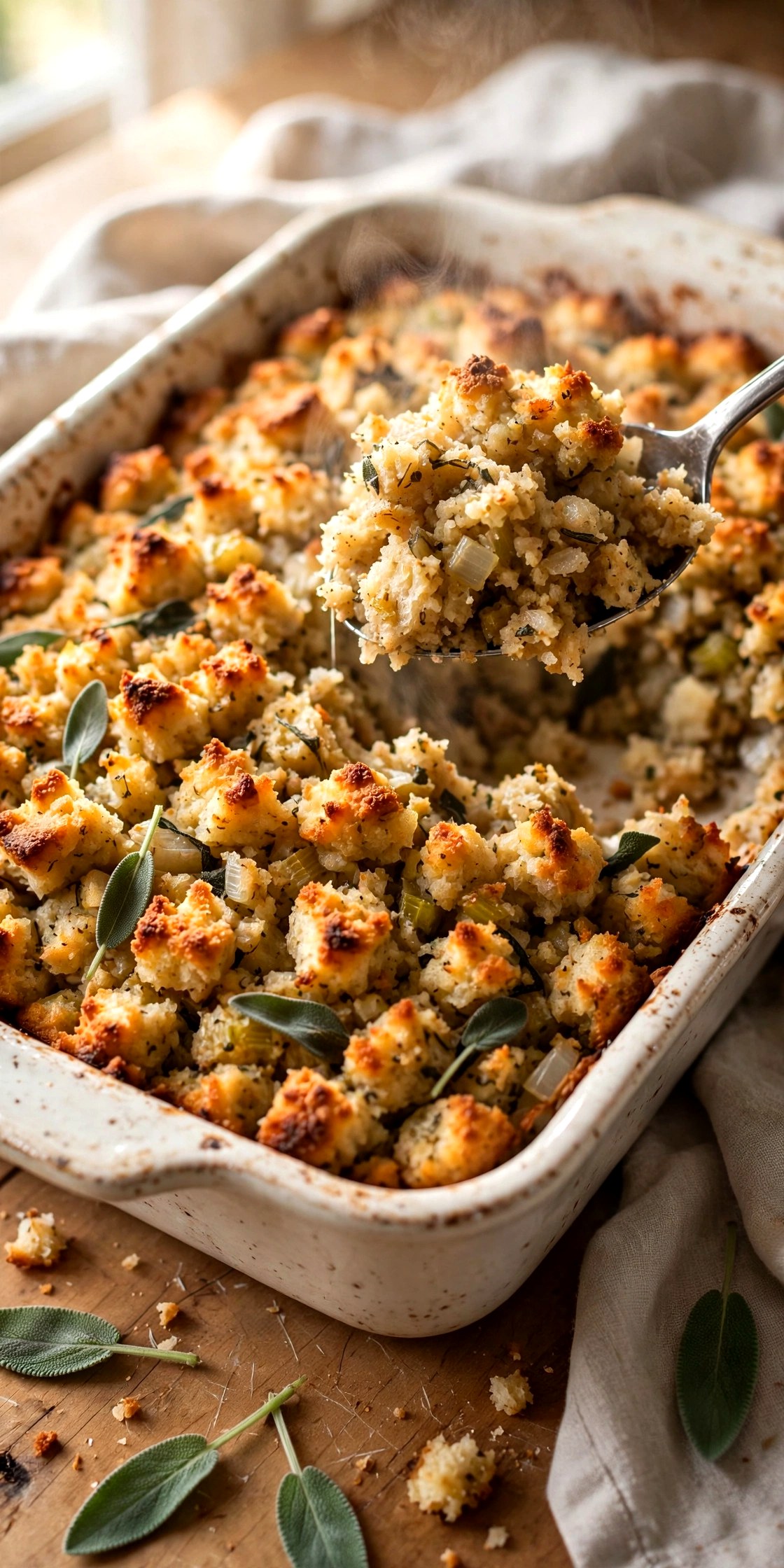
Every family has one dish that starts an argument, and in mine it is the stuffing. Not whether we serve it — that was settled decades ago — but who gets the corner pieces, the ones with the crisp golden top and the soft, buttery middle in the same bite. My grandmother settled it the only fair way she knew: she made a second, smaller dish “for the kitchen,” which the cook (her) somehow finished half of before dinner. I have carried on that tradition exactly, and I am not sorry. This is her stuffing, the classic sage version, written down properly for the first time.
There is nothing fancy in this pan, and that is the point. Day-old bread, a generous hand with butter, onion and celery cooked until sweet, and enough fresh sage to make the whole house smell like Thanksgiving before the turkey even goes in. The secret is the texture contrast: well-moistened (never soupy) bread, baked covered so the center steams soft, then uncovered so the top turns shatteringly crisp. Make it once this way and the corner-piece argument will start at your table too.
Why You’ll Love This Recipe
- Two textures, one pan: A crisp, golden, buttery top over a soft, custardy center — every scoop gets a bit of both.
- The classic flavor, done right: Fresh sage, thyme, and poultry seasoning in proper balance — herby and warm, never bitter or dusty.
- Make-ahead friendly: Assemble it the day before and bake while the turkey rests. Thanksgiving Day you will thank yourself.
- Endlessly adaptable: Sausage, apple, mushrooms, cornbread — the base method takes variations without breaking (see below).

Ingredients
Method
- If your bread is fresh, dry it out first: spread the cubes on two sheet pans and bake at 300°F (150°C) for 15 to 20 minutes, until dry to the touch but not browned. Day-old bread can skip this step. Place the cubes in your largest mixing bowl.
- Preheat the oven to 350°F (175°C). Butter a 9×13-inch baking dish generously.
- Melt the butter in a large skillet over medium heat. Add the onion and celery with a pinch of the salt and cook, stirring now and then, for 8 to 10 minutes, until very soft and sweet smelling but not browned. Stir in the garlic, sage, thyme, and poultry seasoning and cook 1 minute more, until the herbs bloom in the butter.
- Scrape the butter and vegetables over the bread cubes. Add the parsley, the remaining salt, and the pepper, and toss gently with your hands or a big spoon until every cube has met the butter.
- Whisk the beaten eggs into 2 1/2 cups of the warm stock. Pour it over the bread a little at a time, tossing between additions. The cubes should feel thoroughly moist and hold together when squeezed, but there should be no puddle of stock in the bottom of the bowl. Add the remaining stock, a splash at a time, only if the mixture still looks dry.
- Transfer the stuffing to the prepared dish and spread it into an even layer, pressing down very lightly — pack the corners a little more firmly if you want extra-crisp corner pieces.
- Cover the dish tightly with foil and bake at 350°F (175°C) for 30 minutes, until the center is steaming hot and set.
- Remove the foil and bake 10 to 15 minutes more, until the top is deeply golden and crisp at the edges. Rest 10 minutes before serving — the center finishes setting and slices (or scoops) much better.
Tips from Chef Lea
- Dry bread is the whole ballgame. Fresh bread turns to mush the second the stock hits it, and no amount of baking brings the texture back. I cube my loaf the night before and leave the trays on the counter, covered with a clean towel. If I’m starting from a fresh loaf the same day, the low oven at 300°F (150°C) does the job — just don’t let it toast brown, or the stuffing tastes like croutons.
- Add the stock like you mean it — gradually. The single mistake I see most is dumping in all the liquid at once. Bread loaves vary, and once stuffing is soggy, it’s soggy. I pour in about two-thirds, toss, and squeeze a cube: it should feel like a wrung-out sponge, moist all the way through with no drip. You can always add a splash more. You can never take one back.
- Taste it BEFORE the eggs go in. Once the raw egg is in the bowl, tasting stops, so I season, toss, and take my test bite while it’s still just bread, butter, and stock. Stuffing goes bland in the oven more than people expect — it should taste a touch saltier than perfect before it bakes.
- Covered, then uncovered — never one or the other. All uncovered and the top dries out before the center sets; all covered and you get a steamed, pale top that nobody fights over. Thirty minutes under foil, then 10 to 15 minutes bare at 350°F (175°C), gives you both textures in one pan. That’s the corner-piece magic.
Variations
- Sausage sage stuffing: Brown 1 pound of breakfast or Italian sausage, crumble it, and fold it in with its drippings in place of 1/4 cup of the butter. Reduce the salt to 1 teaspoon.
- Apple and walnut: Stir in 1 finely diced tart apple and 3/4 cup of toasted chopped walnuts. Lovely beside turkey and even better beside ham.
- Half cornbread: Swap half the bread cubes for day-old cornbread cubes. The flavor goes deeper and a little sweeter — reduce the stock slightly, since cornbread drinks less.
- Mushroom vegetarian: Cook 8 ounces of sliced mushrooms in the butter until golden before adding the onion, use vegetable stock, and add an extra tablespoon of sage. Nobody misses a thing.
Make Ahead & Storage
Make ahead: Assemble the stuffing (through step 6) up to 24 hours ahead, cover, and refrigerate. Bake straight from the fridge, adding about 10 minutes to the covered baking time. The dried bread cubes and the cooked vegetable-butter mixture can also be prepped separately 2 days ahead.
Fridge: Leftovers keep in an airtight container for 3 to 4 days.
Freezer: Freeze baked, cooled stuffing in portions for up to 3 months. Thaw overnight in the fridge before reheating.
Reheating: Sprinkle a spoonful or two of stock over the top, cover with foil, and warm at 325°F (165°C) for 15 to 20 minutes; uncover for the last 5 minutes to re-crisp the top. A single serving reheats beautifully in a skillet with a knob of butter — crisp edges all the way through.
FAQ
Is this stuffing or dressing?
Technically, dressing — it bakes in a dish, not inside the bird. My family has called it stuffing for three generations and I am not about to referee that one. I bake it separately on purpose: it cooks evenly, the top crisps, and there’s no food-safety guessing.
Can I cook it inside the turkey?
You can, but I don’t recommend it. To be safe, the center of in-bird stuffing must reach 165°F (74°C), and by the time it does, the breast meat is usually overcooked. Bake it in its own dish beside the bird and everyone wins — spoon a little pan dripping over the top if you want that roasted flavor.
My stuffing came out soggy. What happened?
Almost always one of two things: the bread wasn’t dry enough, or all the stock went in at once. Next time, dry the bread thoroughly and add the stock gradually. To rescue a soggy batch, spread it on a sheet pan and bake at 350°F (175°C) for 10 minutes to drive off moisture and crisp it up.
My stuffing looks dry before baking. Help!
Add warm stock a few tablespoons at a time, tossing gently, until a squeezed handful holds together without dripping. Remember it will absorb a little more as it sits, so err on the slightly moist side.
Can I make it gluten-free?
Yes — use a sturdy gluten-free loaf, dried well, and the method is identical. Choose a loaf with some structure; very soft sandwich-style gluten-free bread can go pasty, so the drying step matters even more.
More Dinner Recipes You’ll Love
Conclusion
Some dishes feed people, and some dishes start traditions — the good ones, with arguments over corner pieces and a secret second pan “for the kitchen.” This classic sage stuffing is firmly the second kind: golden, crisp, soft, buttery, and smelling like every good Thanksgiving you’ve ever walked into. Make the extra dish. You’ll understand by dessert. Happy Thanksgiving from my kitchen to yours! 🦃
Follow along for a new recipe every day: find me on Facebook at Lea Recipes Kitchen, on Pinterest at @learecipes, and on Instagram @lea_recipes1. If you make this stuffing, I’d love it if you’d leave the recipe a star rating and a comment — it truly helps other home cooks find it. Thank you! 💛
Leave a Reply