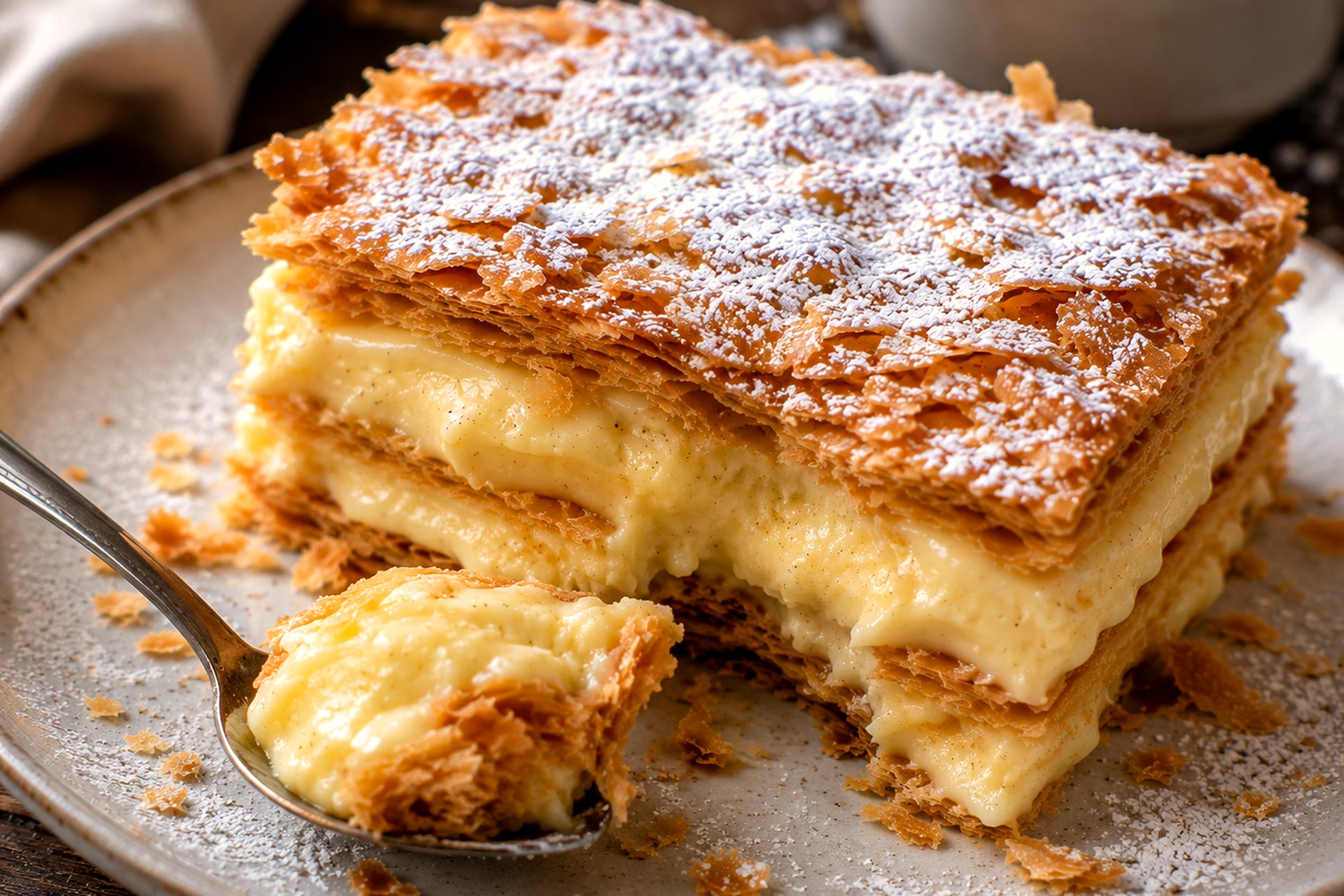
The first time I ever tasted a mille-feuille, I was standing at the counter of a tiny Paris pâtisserie with powdered sugar already on my coat. One bite — that shattering crunch of caramel-gold pastry giving way to cold, silky vanilla cream — and I understood why the French have been making this dessert for centuries. Its name means “a thousand leaves,” and when it is done right, it honestly eats like a thousand delicate layers.
Back home, I was determined to recreate it in my own kitchen, without a professional pastry lab and without laminating dough from scratch. After many trays of puffed-up, lopsided pastry and more batches of custard than I care to count, this is the version that finally worked — and it has been my celebration dessert ever since. Three crisp layers of all-butter puff pastry, a generous spread of real vanilla pastry cream, and a snowy blanket of powdered sugar. That is all a great mille-feuille needs.
Do not let the elegant looks intimidate you. The work splits into two simple jobs — baking the pastry flat and golden, and stirring one pot of pastry cream — and both can be done ahead. If you can whisk a custard, you can make this dessert, and I will walk you through every little trick I learned along the way.
Why You’ll Love This Recipe
- Bakery looks, home-kitchen effort: good store-bought all-butter puff pastry does all the laminating for you, so you get hundreds of flaky layers with zero folding and resting.
- That famous shattering crunch: baking the pastry sandwiched between two trays keeps it perfectly flat and evenly crisp, so every layer cracks cleanly under your fork instead of flying across the plate.
- Silky, honest vanilla cream: the pastry cream is rich with egg yolks and real vanilla but never heavy or gluey — it tastes like the filling of the best Parisian bakery case.
- Made for making ahead: the cream keeps for two days and the baked layers wait happily overnight, so on the day you serve it, assembly takes about ten relaxed minutes.

Easy Homemade Mille-Feuille (Napoleon Pastry)
Ingredients
Method
- Preheat the oven to 400°F (200°C). Place the puff pastry sheets on parchment-lined baking trays, prick all over with a fork, cover with parchment and a second baking tray to keep the pastry flat, and bake for 20–25 minutes until deeply golden and crisp. Cool completely.
- Heat the milk in a saucepan until just steaming. In a separate bowl, whisk the egg yolks, sugar, cornstarch and salt until smooth.
- Temper by slowly pouring the warm milk into the egg mixture while whisking constantly, then return the mixture to the saucepan.
- Cook over medium heat, whisking constantly, until thick and smooth. Remove from the heat and stir in the butter and vanilla.
- Transfer the pastry cream to a bowl, press plastic wrap directly on the surface, and refrigerate for at least 2 hours until completely cold.
- Trim the baked pastry into equal rectangles with a sharp serrated knife.
- Assemble: place one pastry rectangle, spread an even layer of chilled pastry cream, add a second pastry layer, more cream, and finish with the final pastry rectangle.
- Dust generously with powdered sugar just before serving. Chill the assembled mille-feuille for 20–30 minutes before slicing with a serrated knife.
Tips from Chef Lea
Dock the pastry like you mean it. Before the trays go in the oven, I prick the puff pastry all over with a fork, leaving barely half an inch between holes. This is not decoration — every un-pricked patch is a spot where steam will balloon the pastry into a lopsided dome, and domes cannot be stacked. Then I cover the pastry with a second sheet of parchment and a second baking tray. That gentle weight is the whole secret to the flat, even, bakery-style layers a mille-feuille needs.
Bake it darker than you think. Pale puff pastry looks pretty and tastes like disappointment — it goes soft the moment the cream touches it. I bake at 400°F (200°C) for a full 20–25 minutes, until the layers are a deep, confident amber all the way to the center of the sheet. That deep color is caramelized flavor, and it is also your insurance policy: properly baked pastry stays crisp for hours under the cream instead of minutes. If you like, sprinkle the top sheet with the optional granulated sugar before baking for a thin, glassy caramel finish.
Temper slowly, then whisk without walking away. Scrambled-egg custard is the only real way to ruin pastry cream, and it happens when hot milk hits the yolks all at once. Pour the steaming milk in a thin, slow stream while whisking constantly, and the yolks warm up gently. Back on the heat, keep the whisk moving in every corner of the pan until the cream thickens enough to hold a clear trail when you drag the whisk through it. The second it looks thick and glossy, get it off the heat — it keeps cooking in the hot pan.
Cold cream, cool pastry, no exceptions. Warm pastry cream melts into warm pastry and turns all those crisp layers to sponge, so I never assemble until both parts are completely cold. The cream needs its full chill of at least 2 hours with plastic wrap pressed directly on its surface — that contact is what stops a rubbery skin from forming. Right before layering, I give the cold cream a vigorous whisk: it loosens into a smooth, spreadable custard again and pipes or spreads without tearing the delicate pastry.
Slice with a sawing motion, never a press. The classic way to destroy a mille-feuille is to push a knife straight down and watch the cream squeeze out the sides. Chill the assembled pastry for 20–30 minutes so the cream firms up, then use your sharpest serrated knife with long, gentle back-and-forth strokes, letting the teeth do the work. Wipe the blade clean between cuts and you will get those clean, patisserie-window layers every single time.
Variations
- Berry mille-feuille: tuck a layer of fresh raspberries or thinly sliced strawberries into the cream between the pastry layers. The tart fruit against the sweet vanilla cream is gorgeous, and the color at the table is unbeatable.
- Chocolate-hazelnut: spread a whisper-thin layer of chocolate-hazelnut spread or cooled ganache over each baked pastry layer before adding the cream. Keep it thin so the pastry stays the star.
- Espresso cream: whisk 2 teaspoons of instant espresso powder into the hot milk before tempering. Coffee and vanilla together make the dessert taste like a Paris café in the best way.
- Lemon cream: stir the finely grated zest of 1 lemon into the finished pastry cream along with the vanilla, and finish the top with extra powdered sugar. Bright, fresh, and wonderful in spring.
- Salted caramel finish: skip the powdered sugar and drizzle the top layer with warm salted caramel just before serving instead.
Make Ahead & Storage
Make ahead: this dessert is built for it. The vanilla pastry cream can be made up to 2 days in advance — press plastic wrap directly onto the surface so no skin forms, and keep it in the refrigerator until you are ready to assemble. The baked puff pastry layers can be made 1 day ahead; let them cool completely, then store them in an airtight container at room temperature so they stay crisp.
Fridge: once assembled, the mille-feuille keeps in the refrigerator in an airtight container for up to 2 days. I will be honest with you, though: it is at its absolute best within the first few hours, while the pastry still shatters. After that the layers gradually soften into something more cake-like — still delicious, just different.
Freezer: I do not recommend freezing the assembled mille-feuille. The pastry loses its delicate crispness as it thaws and the pastry cream can weep and turn grainy. If you want a head start for a special occasion, make the two components ahead as described above instead of freezing the finished dessert.
Serving and re-crisping: serve the mille-feuille well chilled, and dust the top generously with powdered sugar at the very last moment — if it sits on the pastry too long it melts into the surface and disappears. If your unfilled baked pastry layers have softened slightly overnight, you can re-crisp them in a 350°F (175°C) oven for 3–5 minutes, then let them cool completely before assembling. Never try to warm the assembled dessert; the cream would melt.
FAQ
Why did my puff pastry puff up in uneven bubbles?
Steam is the culprit. As the butter in the pastry melts, it creates steam that wants to lift the layers — that lift is lovely in a croissant but ruinous here. The fix is twofold: dock the raw pastry thoroughly with a fork so the steam has escape routes, and bake it weighted under a second tray so it physically cannot dome. If one small bubble still sneaks through, just press it down gently with the flat of a spatula the moment the tray comes out of the oven.
Can I really use store-bought puff pastry?
Absolutely — this recipe was written for it, and I use it myself. Choose an all-butter puff pastry if you can find one, because butter is where nearly all the flavor lives in a dessert this simple. Thaw the sheets overnight in the refrigerator rather than on the counter, and work with them while they are still cold and firm; warm puff pastry sticks, stretches, and bakes up unevenly.
Help — my pastry cream is lumpy. What went wrong?
Lumps almost always mean a little of the egg yolk cooked too fast — either the hot milk went in too quickly during tempering, or the cream sat unwatched on the heat and caught at the bottom of the pan. The good news is that it is nearly always fixable: pour the hot cream through a fine-mesh sieve into a clean bowl and whisk well; the sieve catches the lumps and the cream underneath is usually perfectly smooth. Next time, temper more slowly and whisk constantly, scraping the corners of the pan.
How do I cut clean slices without the cream squeezing out?
Three things make the difference. First, chill the assembled mille-feuille for 20–30 minutes so the cream firms up and grips the pastry. Second, use a long, sharp serrated knife and saw gently back and forth with almost no downward pressure — pressing straight down is what pushes the filling out. Third, wipe the blade on a clean towel between every cut. Your slices will show neat, distinct layers of pastry and cream, just like the bakery case.
Can I assemble the mille-feuille the day before a party?
You can, but I recommend a middle path. Make both components the day before — the pastry cream keeps beautifully for up to 2 days in the fridge and the baked layers for 1 day in an airtight container — then assemble the dessert on the day, ideally a few hours before serving, and keep it chilled. If you assemble a full day ahead, it will still taste wonderful, but the pastry will have softened and you will lose that signature crunch that makes mille-feuille special.
More Desserts Recipes You’ll Love
Conclusion
A homemade mille-feuille looks like the kind of dessert that only comes from a glass bakery case, but you now know the truth: it is one sheet pan of well-baked puff pastry, one pot of honest vanilla cream, and a little patience while things chill. Make it once for a birthday or a slow Sunday dinner, and I promise it will join your permanent celebration rotation — it has been in mine for years. However yours turns out, be proud of those layers. You made a French classic from scratch, and that is always worth a dusting of powdered sugar.
Follow along for a new recipe every day: find me on Facebook at Lea Recipes Kitchen, on Pinterest at @learecipes, and on Instagram at @lea_recipes1. If you make this Easy Homemade Mille-Feuille, I would love to hear how it went — please leave a comment below and give the recipe a star rating. Your comments and ratings truly help other bakers discover this dessert, and they mean the world to me. Happy baking! — Lea

Leave a Reply